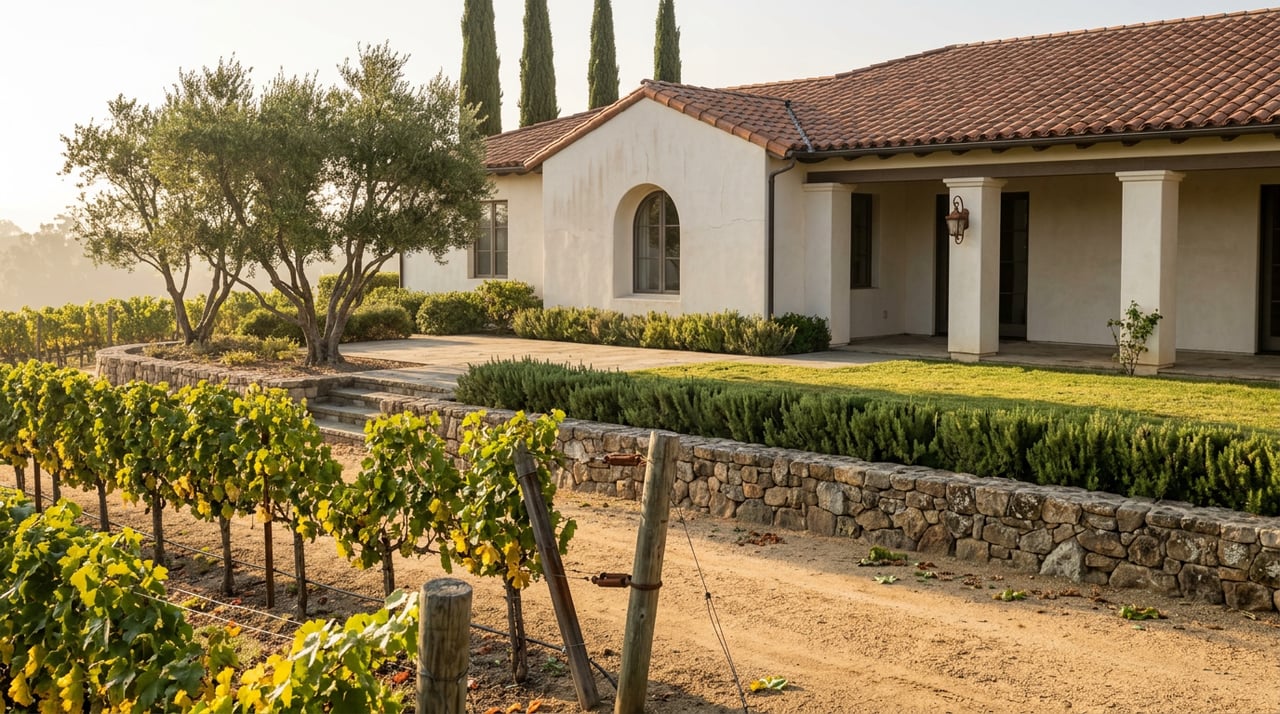
Drive west on Palos Verdes Drive South past Terranea and there is a stretch where the hillside opens up and, if the light is right, you can see rows of vines running down toward the water. Most people driving that road are headed to the resort, or to Trump National, or just circling the loop for the view. Almost none of them know they just passed through part of an officially designated American wine region.
The Palos Verdes Peninsula became the 142nd federally recognized viticultural area in California on June 17, 2021, when the Alcohol and Tobacco Tax and Trade Bureau approved a petition that had been years in the making. The designation covers roughly 15,900 acres across four cities: Palos Verdes Estates, Rolling Hills, Rolling Hills Estates, and Rancho Palos Verdes. It does not extend into the Beach Cities. If your daily loop is Redondo, Hermosa, or Torrance, you're adjacent to wine country, not standing in it.
That distinction matters more than it sounds. An AVA is not a marketing label a city council votes on. It is a legal claim, reviewed by a federal agency, that a specific patch of ground produces grapes different enough from everywhere else to deserve its own name on a bottle. Getting there took the Palos Verdes Peninsula Winegrowers, led by vintner Jim York, roughly three years of soil samples, climate data, and historical documentation before the Trade and Tax Bureau's final rule made it official. Before that, York has said, a label could only claim the wine came from "California." As he put it, people don't know where that is.
Two Vineyards Are Doing All the Work
Here is the part that surprises most residents: the entire commercial side of this designation rests on two family-run properties, both small enough that you could miss them from the road.
Catalina View Wines sits on 94 acres in the Portuguese Bend area of Rancho Palos Verdes, owned by Jim and Kathy York. The vines went in around 2013, the first harvest came in 2016, and the operation now produces somewhere between 600 and 700 cases a year of Pinot Noir and Chardonnay. The grapes are grown entirely on the Peninsula, but the wine itself is made two and a half hours up the coast in Buellton, under veteran Santa Barbara winemaker Ken Brown.
Villa Oneiro is the other half of the story, planted on a hillside near the geographic center of Rolling Hills by Dimitri and Leah Bizoumis, who bought the property in 1999. Their first Chardonnay went in during 2008, Pinot Noir the year after, and the estate now carries about 2,500 vines woven between fig trees, apricots, citrus, and lavender. Production stays small, in the range of a few hundred cases a year, and most of it never leaves the immediate area.
| Catalina View Wines | Villa Oneiro | |
|---|---|---|
| Location | Rancho Palos Verdes, Portuguese Bend | Rolling Hills |
| First vines planted | 2013 | 2008 (Chardonnay), 2009 (Pinot Noir) |
| Approximate vine count | 6,000 | 2,500 |
| Annual production | 600 to 700 cases | About 275 cases |
| Where it's made | Buellton, with winemaker Ken Brown | Not publicly disclosed |
| Where locals find it | Terranea, The Strand House, Malaga Cove Ranch Market, Lunada Market and Deli, Uncorked Wine Shops, and several other South Bay spots | Terranea's Lobby Bar and Sea Beans |
Neither operation is trying to become the next Sonoma. Both sell almost exclusively within a few miles of where the grapes grow, which means the wine most residents will ever taste of their own hillside comes from a restaurant list or a market shelf they already pass every week.
Why It Doesn't Taste Like Santa Barbara
The reason this stretch of coastline qualified for its own AVA in the first place comes down to a climate quirk that sounds small until a winemaker explains it. Santa Barbara's coastal vineyards get a heavy fog layer that rolls in most mornings and burns off by afternoon, creating a sharp swing between cool nights and warm days. The Peninsula gets the ocean breeze without nearly as much of that fog.
Terranea's wine director, Alicia Ajolo, has described the effect directly: without that nightly fog to drop the temperature and reset the vines, Peninsula grapes pick up "a little more steeped tea and savory notes" than their fog-cooled cousins to the north. Underneath all of it sits Altamira shale, a geological layer specific to this stretch of coastline that adds its own mineral character to the finished wine.
The result is a place that can grow the same thin-skinned grapes as Santa Barbara, Pinot Noir and Chardonnay along the cooler coastal edge, while the warmer, more inland sections of the Peninsula can support heartier varieties like Merlot and Cabernet Sauvignon. It is one hillside behaving like two different growing regions, which is exactly the kind of variation an AVA petition has to prove exists.
Where You Can Actually Taste It This Month
You do not need an invitation to a private vineyard to try any of this. The Palos Verdes Wine Club runs curated tastings and winemaker dinners open to the public, along with a standing brunch on the last Sunday of every month, and rotates in bottles from wine regions well beyond the Peninsula alongside the local pours.
For the wine itself, the shortest path runs through a handful of places most residents already know by name: Terranea, The Strand House in Manhattan Beach, Friends of the Vine in Redondo Beach, Malaga Cove Ranch Market and Lunada Market and Deli in Palos Verdes Estates, and Uncorked Wine Shops in Hermosa Beach and Manhattan Beach. None of it requires a drive north. All of it requires knowing to look.
What's Actually Happening on the Hill Right Now
September is the month this all becomes visible if you know where to look. The growing cycle on these vineyards starts with pruning back in February, runs through a summer of steady tending, and lands at harvest in the late summer to early fall window. Catalina View's crew has described loading picked Pinot Noir grapes into a cold storage truck bound for Buellton at exactly this time of year, the fruit pressed and fermenting within days of coming off the vine.
If you drive that stretch of Palos Verdes Drive South or catch the hillside above Portuguese Bend from the right angle this month, there is a real chance you are looking at an active harvest, not just scenery.
The Roots Go Back Further Than the Label Does
None of this is really new to the Peninsula, even if the AVA designation is. Long before anyone planted a wine grape here, the hillside supported real agriculture. In the decades before World War II, as many as 70 Japanese farming families worked roughly 3,500 acres across the Peninsula, dry-farming garbanzo beans and barley and cultivating flowers on the lower terraces near Portuguese Bend. There is no record of a producing vineyard on the Peninsula from that era. The wine is a recent chapter. The land underneath it has been earning its keep for well over a century.
That is really the point worth sitting with. An AVA does not create a place. It just puts a legal name on something that was already true about the soil, the slope, and the air coming off the water. The Peninsula qualified because two people spent years proving what the hillside had been doing on its own the whole time.
If you have lived here for years and never once connected your neighborhood to an actual wine label, you are not missing something obscure. You are just living somewhere that earned a designation quietly, the way most things on this hill tend to get done.
For more on what makes life across the Peninsula worth paying attention to, from the neighborhoods themselves to the details that make each one distinct, Gayle Probst has spent her career learning this ground one hillside at a time. If a move onto or around the Peninsula is somewhere on your horizon, a complimentary market consultation with Gayle is a good place to start the conversation, and so is a free home valuation if you're simply curious what your own stretch of the hill is worth today.