In December 1923, before anyone had approved a final design, crews began pouring concrete curbs for a business center at Malaga Cove. Farther down the coast, the Palos Verdes Project had a much bigger idea for Lunada Bay. It planned a theater, a post office, a community building and a row of stores, plus a yacht harbor and a seaside pool in the bay below.
Only the curbs at Malaga Cove became the town square they were poured for. Today Malaga Cove Plaza is the one place in Palos Verdes Estates where you can stand inside a commercial center from the original plan, built the way its architects drew it. It was also the smallest center in that plan. Seen that way, the fountain repairs and historic plaques of the last two years are upkeep on the only finished example the city has. The other plaza sites are worth a walk too, because each shows a different point where the plan stopped.
Three Squares, Three Firms
The National Register nomination for Malaga Cove Plaza says the original concept for the Peninsula was "three commercial plazas to serve as neighborhood squares: Malaga Cove, Valmonte, and Lunada Bay." The Palos Verdes Art Jury required a different firm to design each one. Each firm also had to set a standard facade treatment that later lot buyers would follow, with some variation allowed. The plan was a set of village centers, each with its own architectural character and each serving the homes around it.
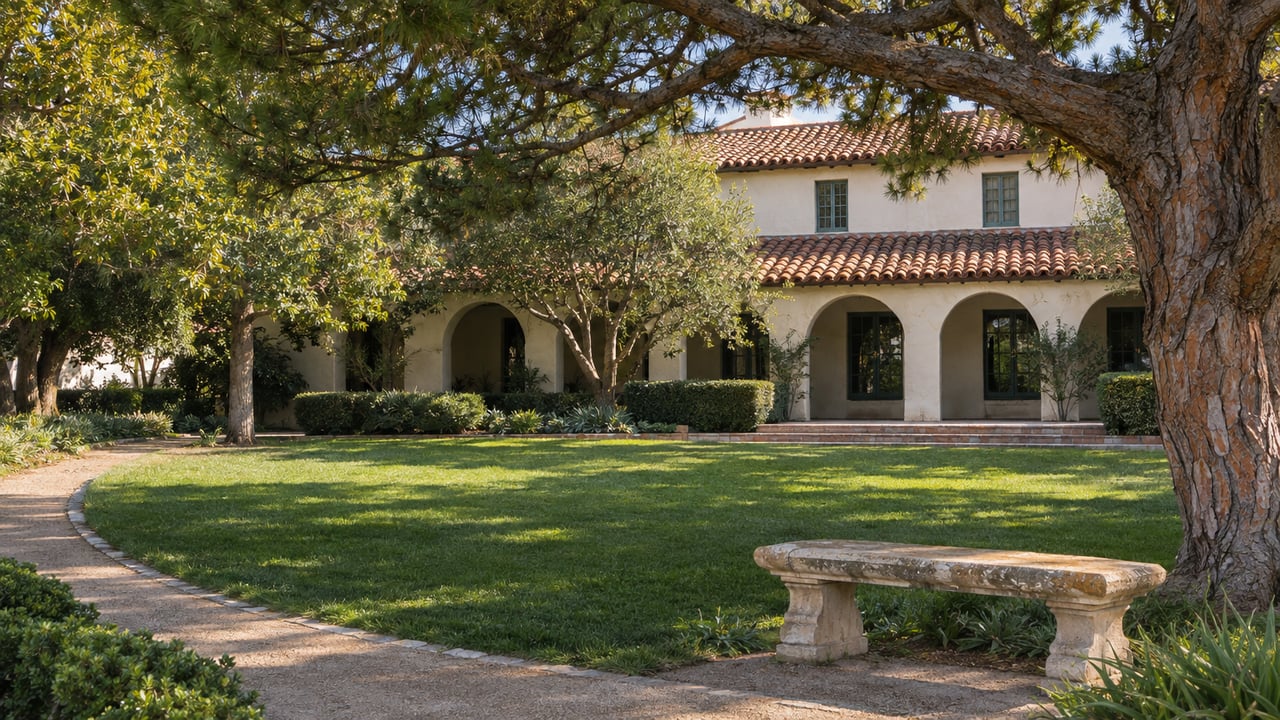
Malaga Cove went to Walter Webber, William Staunton and Sumner Spaulding. Their design was modeled on Spanish and Italian plazas. The Art Jury approved it in November 1924: an open square with arcaded buildings on three sides, two to three stories of masonry, and an arch over the short street at the east side to close the group.
John Phillips is a Palos Verdes Estates homeowner who wrote the Arcadia book Palos Verdes Estates. He told the Daily Breeze in 2011 that the Great Depression, which began in 1929, "was really the event that changed the course of Palos Verdes Estates." In his account, "the Malaga Cove Plaza was the only such business center that was built the way it was designed, and it was the smallest of the plazas." He added that plazas had also been planned for Valmonte, for Miraleste, which was originally part of PVE, and for Montemalaga.
Malaga Cove: The Square That Got Its Buildings
The first building on the plaza was the Gardner Building. W.W. Gardner built it for $51,000, and it was finished in 1925. For its first years it was a civic building more than a shop row. It held the Peninsula's first post office, school, library, drugstore and grocery store. Upstairs were the Art Jury, the Palos Verdes Project's engineering and design departments, and the Homes Association. In practice, the plaza ran the young community before there was a city to do it.
The plaza was dedicated on September 13, 1925. The program had music by the American Legion Band of Hollywood and speeches from the mayors of Los Angeles, Long Beach and Redondo Beach. The nomination quotes a description of the event as "the largest public event so far staged in the history of Palos Verdes." Malaga Cove Green and Olmsted Place were laid out as green space with the plaza and show up in its earliest photographs. The Syndicate Building, now Casa del Portal, followed in 1929 and was designed by the same firm.
Malaga Cove was the plan that went furthest before the Depression, but its buildings kept coming for decades. The Palos Verdes Library District's Doors Open Peninsula guide says most of the district was built between 1925 and 1964, with buildings by Walter Swindle Davis, Sumner Spaulding and Carrington Lewis and open space by the Olmsted Brothers. Lewis was hired in 1956 to design a Security First National Bank branch on the plaza. The Palos Verdes Peninsula News described it in November 1956 as "Village type architecture of Italian derivation in conformity with existing concepts as approved by the Palos Verdes Art Jury," according to the National Register nomination. Thirty years after the first building, new work was still designed to match the 1924 approval.
The Fountain at the Center
The Neptune Fountain in the middle of the plaza has a longer history than the buildings around it. Artist Lynne La Fleur wrote the full account for Palos Verdes Pulse. The statue is an 1814 replica of the Fontana del Nettuno in Bologna, Italy, which went up in 1563. The Palos Verdes Project bought it, shipped it to the Peninsula, and dedicated it on February 16, 1930.
Vandalism got so bad that the statue was taken down in 1968 and stored in a shipping crate in a shed. At one point its head was stolen and later returned. In May 1987, Morynne Motley, who with Robert Motley had recently bought the Syndicate Building, started organizing support to restore the fountain and the plaza. According to La Fleur, that restoration took more than a decade.
The most recent repair was celebrated on the evening of July 17, 2025. The PVE Foundation and community donors paid for it. Quinn Construction restored the marble facade, rebuilt the inner plumbing, installed LED lighting, and repaired the head of the cherub that sits at Neptune's feet holding a dolphin.
A year later, on July 24, 2026, the city marked a different milestone. A plaque recognizing Malaga Cove Plaza's 2021 listing on the National Register of Historic Places was dedicated at Olmsted Place Park, the Daily Breeze reported. Olmsted Place is one of the two green spaces laid out with the original plaza, so the plaque marking the plaza's history sits on ground that was part of the 1920s plan.
The plaza still changes. In September 2025, a city resolution took up a conditional use permit for a café at 36 Malaga Cove Plaza, with indoor and outdoor seating and wine service.
Lunada Bay: The Biggest Plan, Built Later and Smaller
In Phillips's telling, Lunada Bay was meant to be the main event. "The biggest plaza was going to be at Lunada Bay, which was designed by Kirkland Cutter," he told the Daily Breeze. "It was going to be this large, beautiful plaza, but it never came to fruition because of the Depression." The library district's guide lists what was planned: a theater, a post office, a community building, a variety of stores, and a yacht harbor and seaside pool in the bay. The Olmsted Brothers archive also holds an undated drawing titled "Plaza Lunada / Via Mirola."
The grand plaza was to sit at Via Mirola. What the neighborhood got instead was a scaled-down center a little north, at Yarmouth Road, and its first commercial building, on the north side of Yarmouth, went up in 1956. Today the Library District lists Lunada Bay Plaza at 2201 Palos Verdes Drive West at Yarmouth Road. Carrington Lewis, the architect behind the 1956 bank at Malaga Cove, was later credited with the "first two-story commercial structure in Lunada Bay Center of Palos Verdes Estates." He also designed a classical fountain for "the triangular parkway in Lunada Bay Plaza where Yarmouth Road intersects Palos Verdes Drive West." The plaque at the fountain in that median names it "Fuente de los Niños," the fountain of the children, because about 250 neighborhood children raised the money for it in a drive organized by Rocky Point resident Jeane Burke. The 1920s plan imagined a theater and a harbor. What got built was a postwar neighborhood center designed by an architect who also worked within the Art Jury's terms at Malaga Cove.
The Lunada Bay Homeowners Association calls the plaza "our local hangout," a place for lunch with friends, a snack on the way to work or school, or a weekend afternoon. The association says it is working with the city on pedestrian safety, more seating, landscaping and new signage criteria, and describes the project as being in the final stages of development. Seating and a better pedestrian setting are what a town square is for, so this project is the neighborhood adding some of the gathering function the original plaza never got. Down the bluff, the trail work below Lunada Bay has its own timeline.
Valmonte and Montemalaga: Plazas on Paper
Valmonte was the third of the original three squares in the nomination's account. The Palos Verdes Library District's local history archive holds an architect's rendering of the proposed Valmonte Plaza, dated to about 1925. Phillips counts Valmonte and Montemalaga among the plaza plans that "didn't come to be." The rendering is the clearest picture of a Valmonte village center, and anyone can look it up in the library district's online collection.
Miraleste: The Plaza That Left the City
Miraleste Plaza at 19 Miraleste Plaza dates to 1924. Miraleste was one of the six original residential communities of the Palos Verdes Project. Today it is in Rancho Palos Verdes, but the library district's guide says the community, about 300 acres and 377 homes, is still under the covenants of the Palos Verdes Homes Association and Art Jury. Carrington Lewis appears here too, credited with a $100,000 professional building in Miraleste Plaza. Rancho Palos Verdes' 2026 active business-license list includes Miraleste Hairstylists at 29 Miraleste Plaza, and the city's license record shows Francesco's Cafe Italia at 20 Miraleste Plaza with a January 2026 renewal.
Walking the Plan in One Morning
The plan is easy to follow on foot and by car. Start at Malaga Cove Plaza, Palos Verdes Drive West between Via Tejon and Via Corta. Stand at the Neptune Fountain, find the Gardner Building anchoring the west side, then cross to Olmsted Place to read the new plaque. Then drive south on Palos Verdes Drive West to Yarmouth Road and find the children's fountain in the median, then picture the much larger plaza that was meant to stand a little farther south at Via Mirola. A detour to Miraleste Plaza on the east side completes the set of centers that were planned, partly built and still in use. For the house styles you pass along the way, our guide to the architectural styles of Palos Verdes Estates picks up where the plazas leave off.
If you own a home near one of these plazas and want to know how its history and its block figure into its value today, Gayle Probst is glad to help. Call Gayle for a complimentary market consultation or a free home valuation, and she will talk through what makes your corner of Palos Verdes Estates different.